





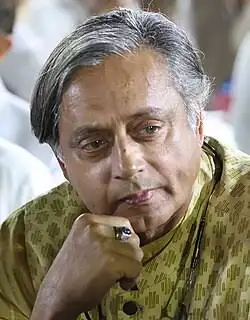
- Senior Congress leader Shashi Tharoor has stirred political debate after defending veteran Bharatiya Janata Party (BJP) leader L. K. Advani on social media, prompting his own party to publicly distance itself from his remarks. On Saturday, Tharoor took to X (formerly Twitter) to extend birthday wishes to Advani on his 98th birthday. In his post, Tharoor described the BJP stalwart as a man of “unwavering commitment to public service,” praising his modesty, decency, and role in shaping modern India.
However, it was Tharoor’s follow-up comments that drew attention. He argued that Advani’s decades-long political career should not be reduced to a single controversial episode — widely interpreted as a reference to the Babri Masjid demolition. Tharoor wrote that “the totality of Nehruji’s career cannot be judged by the China setback, nor Indira Gandhi’s by the Emergency alone,” suggesting that Advani, too, deserved the same historical fairness. His attempt to place Advani’s political contributions within a broader context sparked intense debate both within and outside the Congress party.
The Congress leadership swiftly issued a statement distancing itself from Tharoor’s remarks. Party spokesperson Pawan Khera clarified that Tharoor’s views were his own and did not represent the official position of the Indian National Congress. “Like always, Dr. Shashi Tharoor speaks for himself, and the Indian National Congress outrightly dissociates itself from his most recent statement,” Khera said. At the same time, he added that Tharoor’s freedom to express individual opinions reflected the “democratic and liberal spirit” that the Congress has always upheld.
This is not the first time that Tharoor’s independent views have caused discomfort within his party. Known for his articulate and nuanced positions, he has occasionally diverged from the Congress line on sensitive political and historical issues. His defense of Advani — a figure central to the rise of the BJP — has reignited internal discussions about how far party leaders can go in expressing personal opinions that may contradict collective positions.
Political analysts note that Tharoor’s remarks, while couched in civility, have significant implications. By comparing Advani’s legacy to those of Jawaharlal Nehru and Indira Gandhi, Tharoor appeared to be advocating for a more generous, historically balanced view of political legacies across party lines. However, given the polarizing nature of Indian politics, such gestures are often interpreted as ideological leniency toward the rival camp.
As of now, Tharoor has stood by his statement, maintaining that it was unfair to judge a long public career by one episode. The Congress, however, seems eager to move past the controversy, reiterating that the party’s focus remains on its current political and policy priorities. The episode underscores a recurring tension within the Congress — between its tradition of internal freedom and the challenge of maintaining a unified public stance in a deeply polarized political environment.