





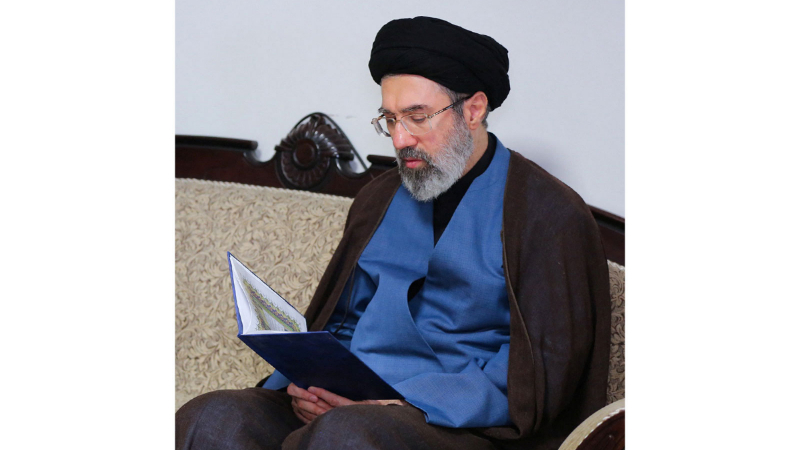
Iran has appointed Mojtaba Khamenei as the country’s new Supreme Leader, just days after the death of his father, Ayatollah Ali Khamenei, who was reportedly killed in a joint attack carried out by the United States and Israel. The decision was confirmed late last night by Iran’s Assembly of Experts, the powerful body responsible for selecting the country’s highest authority.
In a statement issued after the vote, the Assembly announced: “By a decisive vote, the Assembly of Experts appointed Ayatollah Seyyed Mojtaba Hosseini Khamenei as the third Leader of the sacred system of the Islamic Republic of Iran.” The Assembly consists of 88 clerics who are tasked with choosing and supervising the Supreme Leader.
Mojtaba Khamenei, 56, has long been considered a potential successor to his father, though his possible rise to power had previously drawn criticism internationally. Former United States President Donald Trump had earlier described the prospect of Mojtaba becoming Supreme Leader as “unacceptable.”
A Low-Profile Figure Close to Power
Despite his limited public presence, Mojtaba Khamenei has spent decades operating within the inner circles of power in Iran. He has largely remained outside formal political office but has worked closely within the Office of the Supreme Leader, where he was widely regarded as a key power broker and gatekeeper to his father.
Born in 1969 in Mashhad, a major religious city in northeastern Iran, Mojtaba is the second-eldest son of Ayatollah Ali Khamenei, who had six children. He pursued religious studies in the seminaries of Qom, the country’s main center for Shi’ite theological learning, and currently holds the clerical rank of Hojjatoleslam.
However, one of the most debated aspects of his appointment is that he has not attained the rank of Ayatollah, a status traditionally associated with those who hold Iran’s highest religious authority. This has been a point of discussion among senior clerics regarding the legitimacy of his leadership.
Early Life and Rise in Influence
Mojtaba first drew public attention in the late 1990s as his father’s power became firmly entrenched within the Islamic Republic. Known for his striking resemblance to Ayatollah Ali Khamenei, Mojtaba often wears the black turban that signifies descent from the Prophet Muhammad, marking him as a sayyed.
At the age of 17, he briefly served during the Iran-Iraq War, where he reportedly established relationships with figures who later rose through the ranks of Iran’s security and intelligence services.
Over time, his influence grew within the political and security establishment. Much of his reputation has been tied to his close ties with Iran’s powerful Islamic Revolutionary Guard Corps (IRGC) and his support for conservative and hardline factions within the country’s leadership.
US Sanctions and International Scrutiny
In 2019, the United States imposed sanctions on Mojtaba Khamenei, accusing him of acting on behalf of his father despite holding no official government position. The US Treasury Department alleged that Ayatollah Ali Khamenei had delegated certain responsibilities to Mojtaba, enabling him to advance policies tied to Iran’s regional ambitions and domestic political control.
Controversies and Political Influence
Mojtaba Khamenei has also been a controversial figure within Iran’s political landscape. His name surfaced during the widespread protests that followed the death of a young woman in police custody in 2022 after she had been detained for allegedly violating Iran’s strict dress code laws.
In 2024, speculation about his activities increased when a video circulated online showing him announcing the suspension of the Islamic jurisprudence classes he had been teaching in Qom.
He has also been widely believed to have played a role in the political rise of hardline president Mahmoud Ahmadinejad, who was elected in 2005. Mojtaba reportedly supported Ahmadinejad during the disputed 2009 election, which triggered mass protests across Iran.
At the time, moderate cleric Mehdi Karroubi accused Mojtaba of interfering in the electoral process in a letter addressed to Ayatollah Ali Khamenei. The allegations were firmly rejected by the Supreme Leader.
Personal Life
In 2004, Mojtaba married Zahra Haddad-Adel, the daughter of influential conservative politician and former parliament speaker Gholamali Haddad-Adel. The marriage strengthened ties between the Khamenei family and powerful conservative political networks.
The couple had three children together. However, Zahra Haddad-Adel was reportedly killed in the recent strikes in Tehran.
Wealth and Business Interests
Reports have also suggested that Mojtaba Khamenei built a substantial international network of property and investments. While his exact wealth is not publicly known, several reports have described him as a multi-millionaire.
According to reports cited by Bloomberg, Mojtaba has held bank accounts in Switzerland and owns a luxury property in the United Kingdom valued at more than $138 million. He is also believed to have shipping interests in the Persian Gulf and multiple luxury properties in London and Dubai. Some reports further claim he owns luxury hotels across Europe.
A Potential Shift in Leadership Style
The leadership transition may mark a shift in Iran’s political structure. Ayatollah Ali Khamenei, a central figure of the revolutionary generation, built his authority through ideological legitimacy and decades of balancing competing political factions.
Mojtaba Khamenei, however, is often seen as more closely aligned with Iran’s security institutions, particularly the IRGC. Analysts suggest this could signal a stronger role for the security establishment in shaping Iran’s future political direction.
While his leadership style remains to be seen, many observers believe that Mojtaba’s reliance on security networks rather than public religious authority could further deepen the existing trend toward the securitisation of Iranian politics.