





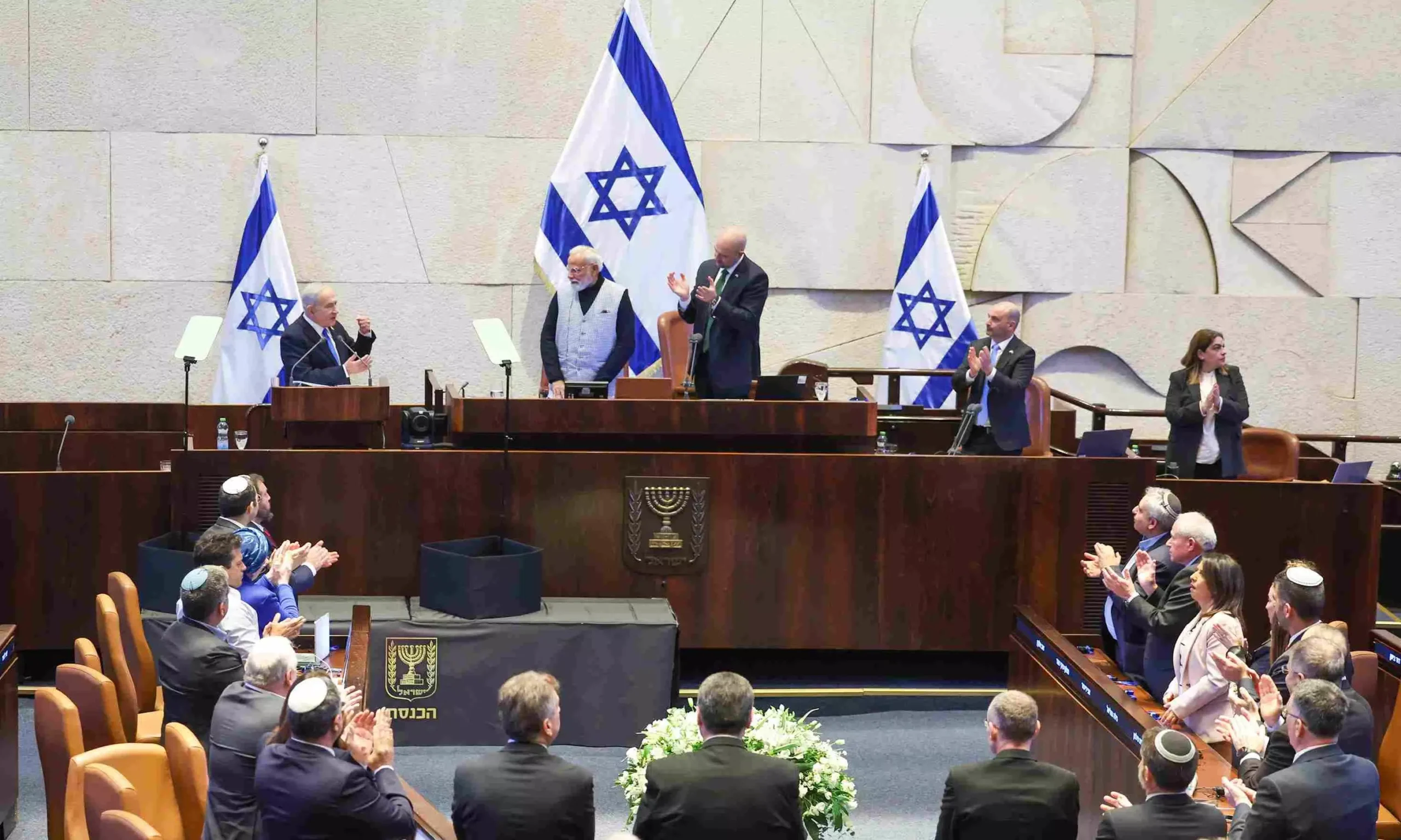
Prime Minister Narendra Modi’s state visit to Israel has marked another defining moment in the steadily evolving relationship between the two nations. Arriving in Tel Aviv for a two-day visit at the invitation of Israeli Prime Minister Benjamin Netanyahu, Modi was welcomed with warmth that reflected not just diplomatic courtesy but a visibly close personal rapport between the two leaders. Netanyahu’s public gestures and remarks underscored the importance Israel attaches to its ties with India, especially at a time of heightened geopolitical tensions in the region.
This visit comes at a particularly sensitive moment for Israel, as the country continues to navigate the aftermath of prolonged conflict and complex security challenges. Against this backdrop, Modi’s presence carries strategic weight. His trip signals India’s commitment to maintaining strong bilateral relations with Israel while balancing its broader diplomatic engagements in West Asia. The optics of the visit — the ceremonial welcome, high-level meetings, and public addresses — underline the depth and maturity the relationship has achieved in recent years.
One of the most significant moments of the visit was Prime Minister Modi’s address to the Knesset, Israel’s Parliament. By speaking before Israeli lawmakers, Modi reaffirmed India’s recognition of Israel as a key strategic partner. In his address, he strongly condemned terrorism, describing it as inhuman and unjustifiable under any circumstances. Referring to the October 7, 2023 Hamas attack, he expressed solidarity with the people of Israel and emphasized that India stands firmly against acts of terror targeting innocent civilians. His remarks were clear in tone and direct in message, reiterating India’s long-standing position that terrorism must be opposed in all its forms and manifestations.
At the same time, Modi highlighted the importance of pursuing peace and stability in the region. He reiterated that while India stands in solidarity against terrorism, it also supports efforts toward a just and lasting resolution of ongoing conflicts. This balanced messaging reflects India’s broader foreign policy approach — combining principled positions on security with support for diplomatic dialogue and peaceful outcomes.
The visit also saw Modi being honoured with the Speaker of the Knesset Medal, one of Israel’s highest parliamentary recognitions. The award symbolizes Israel’s acknowledgment of his role in strengthening India-Israel ties and expanding cooperation across multiple domains. Over the past decade, bilateral relations have grown significantly, moving beyond traditional defence cooperation to encompass areas such as technology, agriculture, innovation, cybersecurity, water management, renewable energy, and trade.
Defence and security remain important pillars of the partnership. India and Israel have collaborated extensively in military technology, intelligence sharing, and counter-terrorism cooperation. During the current visit, discussions reportedly focused on enhancing strategic coordination, advancing joint research initiatives, and expanding defence technology partnerships. Given the evolving security landscape in the Middle East and beyond, both sides appear keen to deepen collaboration in ways that strengthen resilience and preparedness.
Economic engagement also featured prominently in discussions. Trade between India and Israel has grown steadily, and both countries are exploring new avenues for collaboration in startups, artificial intelligence, semiconductor technology, health innovation, and clean energy solutions. Israel’s reputation as a global innovation hub aligns well with India’s expanding digital and technological ecosystem. Leaders from both sides expressed interest in fostering greater business-to-business linkages and facilitating smoother investment flows.
Agriculture and water management — long-standing areas of cooperation — continue to be key components of the partnership. Israeli expertise in drip irrigation, desert farming, and water conservation has already been implemented in various Indian states through joint centers of excellence. The visit is expected to further expand these initiatives, particularly in the context of climate change and food security challenges.
Beyond formal agreements and policy discussions, the visit carries symbolic importance. It reflects how far bilateral relations have progressed from cautious engagement in earlier decades to open, strategic collaboration today. Diplomatic ties between India and Israel, formally established in 1992, have grown steadily, but the past decade has seen unprecedented political warmth and public visibility in the relationship.
Modi’s Israel visit also fits within India’s broader West Asia policy, which seeks balanced relations with all key players in the region, including Israel, the Gulf nations, and Iran. By maintaining strong ties with Israel while simultaneously engaging Arab partners, India aims to position itself as a credible and independent global actor capable of navigating complex geopolitical dynamics.
As the visit progresses, it is evident that the India-Israel relationship is entering a new phase characterized by deeper institutional cooperation, strategic alignment on security issues, and expanding economic collaboration. Modi’s engagements in Israel — from high-level meetings to his address at the Knesset — reinforce the message that both countries view each other as trusted partners in an uncertain global environment.
In essence, the visit is not merely ceremonial. It reflects a strategic convergence rooted in shared democratic values, technological ambition, and mutual security concerns. As global power equations continue to shift, India and Israel appear determined to build a partnership that is resilient, forward-looking, and firmly anchored in common interests.