

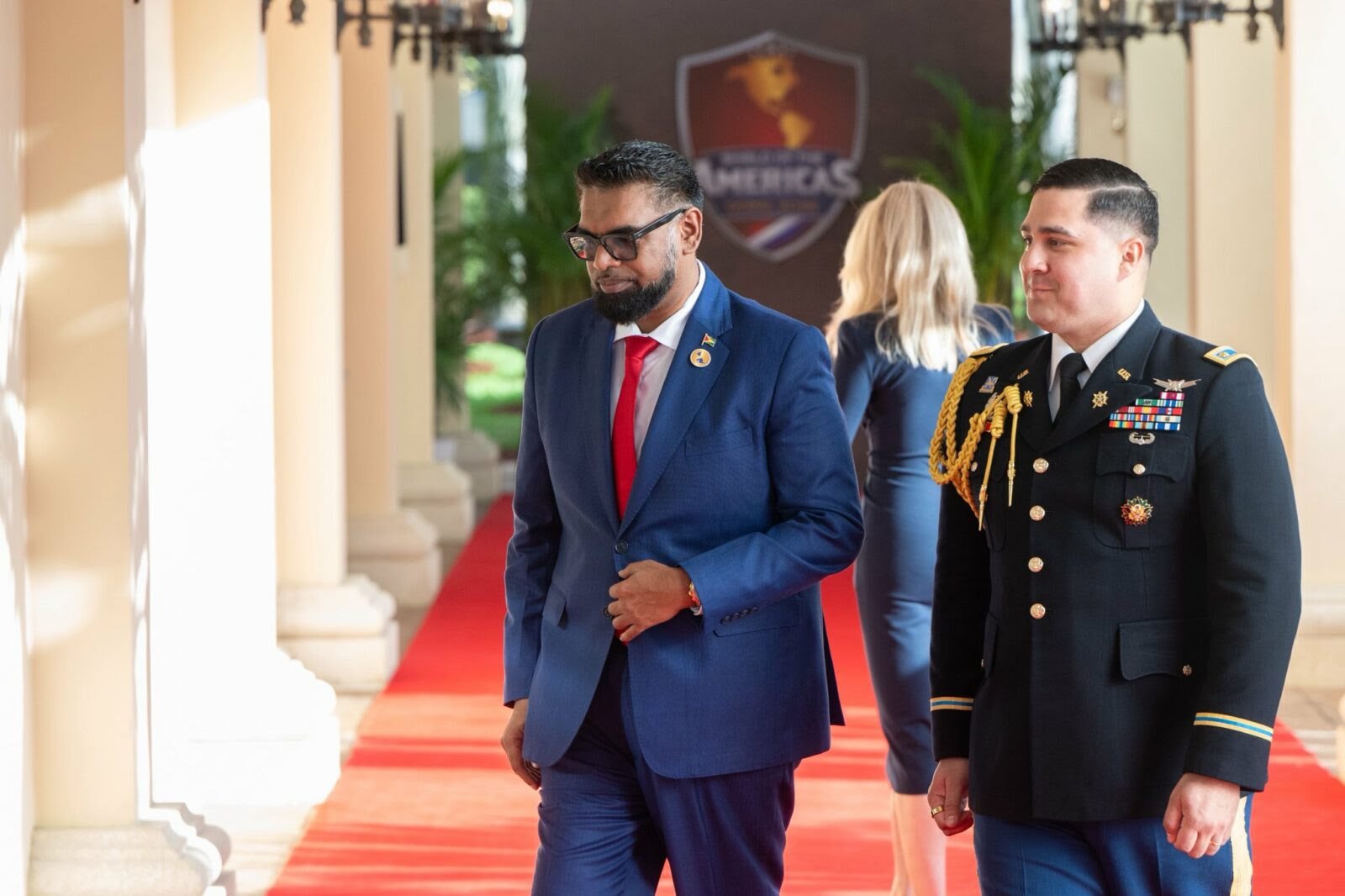
The security climate in the region have improved in recent weeks following major political developments in neighbouring Venezuela.
This is the position of President Dr Mohamed Irfaan Ali who was at the time speaking during an interview with the Fox News on Saturday.
On the sidelines of the Shield of the Americas Summit held in Doral, Miami, Florida, the head of state spoke about several geopolitical issues affecting the Caribbean and Latin America regions, including the developments in Venezuela, governance in Cuba and the fight against drug trafficking organisations.

Guyana, which shares a border with Venezuela, has been closely monitoring the situation, particularly after the recent capture of Venezuelan leader, Nicolás Maduro.
President Ali explained that Guyana had previously experienced tensions linked to the Maduro Administration in Venezuela.
However, the situation has improved significantly following Maduro’s capture.
“That by itself has brought a change in the mindset, a change in the condition, and we have seen greater stability, less rhetoric,” he told the Fox News.
President Ali noted that the Venezuelan government has been making attempts, consistent with agreements with the United States (US) to create a safer national environment for its citizens
These developments, he said, are aimed at improving economic opportunities and promoting democratic governance in Venezuel.
He noted that the shift has already had visible effects on regional stability.
“Wherever there is less rhetoric about conflict, there is greater confidence in the system, and wherever there is momentum towards democracy, there [are] greater prospects for the region,” the president said.
Guyana committed to dismantling drug trafficking networks
Another major topic raised during the interview was the ongoing fight against drug trafficking and organised crime across the region.
President Ali reminded that Caribbean and Latin American countries have long raised concerns about drug cartels.
According to him, these criminal operations frequently exploit the region’s Exclusive Economic Zones and border areas, exposing countries to transnational criminal networks.
“It’s an issue that has exposed the region, has given the region a bad name in terms of drugs. So, we support the strong action on drug cartel,” he reiterated before he said, “We have supported the charter to deal with transnational crime, especially the narco-terrorism and these cartels.”
He said the current approach involves more direct action to protect national borders, reducing criminal activity, and improving the region’s international reputation.
Political developments in Cuba
During the interview, President Ali was also asked about political developments in Cuba and comments made by U.S. President Donald Trump suggesting the country could face significant political change.
In response, he explained that leaders within the Caribbean Community (CARICOM) recently held discussions about Cuba’s situation; U.S. Secretary of State, Marco Rubio was also engaged in these discussions.
During that meeting, he highlighted that regional leaders agreed that the current status quo in Cuba cannot remain unchanged. According to the president, however, any transformation in Cuba must occur gradually.
“There must be dialogue, but those changes must lead to the improvement of the people of Cuba, must lead to better conditions for the people of Cuba, must lead to a society in which the rule of law, in which democracy, in which freedom is celebrated,” he emphasised.
The president is joined by the Minister of Foreign Affairs and International Cooperation, Hugh Todd and Foreign Secretary, Robert Persaud among others.