





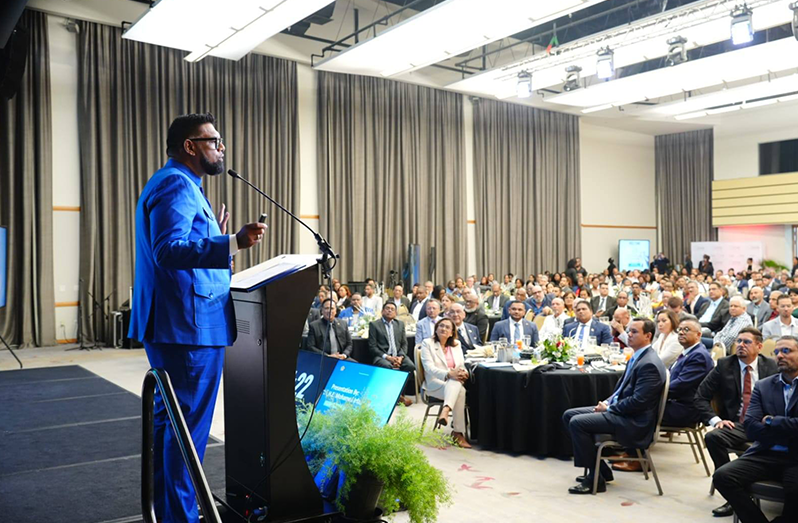
President Dr Irfaan Ali has issued a forceful appeal for a major transformation in how Caribbean economies operate, warning that the region can no longer afford to operate in isolation if it hopes to remain competitive on the world stage. Speaking at the Trinidad and Tobago Chamber of Industry and Commerce’s Annual Business Meeting Outlook 2026/2027, the Guyanese Head of State emphasised that collaboration—not competition among neighbours—must define the region’s economic future.
In his address, President Dr Ali warned that outdated protectionist policies and inward-looking strategies are constraining growth and stifling innovation. He emphasised that the global economy is evolving rapidly, with countries prioritising national and regional interests in increasingly strategic ways. Against this backdrop, he argued that Caribbean nations must rethink their approach and create broader, system-wide opportunities that benefit the entire region.
At the heart of his message was a call for deeper integration—linking production systems, coordinating investment, and building unified economic platforms capable of competing internationally. According to the President, relying on individual national efforts is no longer viable in a world that rewards scale, efficiency, and cooperation. Instead, he urged Caribbean states to combine their strengths and develop a shared framework for growth.
A significant part of the challenge, he noted, lies in dismantling long-standing bureaucratic and policy barriers that continue to restrict trade and business activity across the region. He highlighted customs procedures, logistics inefficiencies, and inconsistent regulations as major obstacles that must be urgently addressed. Without fixing these structural weaknesses, he warned, meaningful partnership will remain out of reach.
President Dr Ali called for a more direct, action-oriented approach to solving these problems, even suggesting that key stakeholders from government and the private sector should hold intensive discussions to deliver quick, practical solutions. His message was clear: the region must move from dialogue to decisive action.
He also emphasised the importance of building partnerships through consortia and joint ventures, particularly in critical sectors such as energy, agriculture, manufacturing, and logistics. By pooling capital, expertise, and resources, Caribbean countries can achieve the scale needed to compete effectively in global markets.
Ultimately, the President stressed that integration aims to strengthen the region’s global competitiveness. He explained that Caribbean products and services must first become competitive in the regional market before expanding beyond it. Without this alignment, individual economies will continue to struggle with limited market access, insufficient scale, and reduced investor attractiveness.
While acknowledging that regional integration has long been discussed, President Dr Ali challenged leaders and businesses to move beyond promises and deliver tangible progress. He framed the issue not as a matter of policy preference but as an urgent necessity for survival and growth in a highly competitive global environment.
His remarks reflect Guyana’s broader strategy to strengthen regional ties and position itself as a driving force behind a more unified, resilient, and globally competitive Caribbean economy.