








When a government is spending billions on the projects it believes will define a generation, the last thing it can afford is for the paperwork to get in the way.
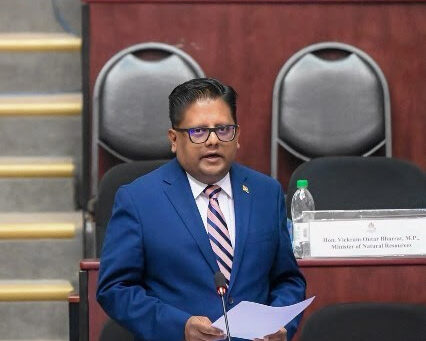
That, in essence, is the story behind four financing amendments tabled in Guyana’s National Assembly on Wednesday by Senior Minister in the Office of the President with Responsibility for Finance, Dr Ashni Singh — quiet but consequential adjustments designed to keep two of the country’s most significant infrastructure projects on course.
The amendments touch two separate undertakings: the Gas-to-Energy Project, which the government has staked much of its energy future on, and the new arrivals terminal at the Cheddi Jagan International Airport. Between them, these two developments represent not just major capital investment, but a clear statement of where Guyana intends to be in the years ahead.
Two of the four amendments concern the credit agreement with the Export-Import Bank of the United States, which is financing the Gas-to-Energy Project. The changes are technical in nature but practical in effect: they simplify how the government submits reimbursement requests and push back the facility’s final disbursement deadline, ensuring that funding remains available across the full arc of construction and commissioning.
The Gas-to-Energy Project is one of the most ambitious energy undertakings in Guyana’s history. When complete, it is expected to substantially increase the country’s electricity generation capacity and bring down the cost of power — both for households and for the businesses and industries that underpin economic growth. Getting the financing arrangements right, and keeping them flexible enough to absorb the realities of large-scale construction, is not a bureaucratic nicety. It is a practical necessity.
The Ministry of Finance was clear on that point: the adjustments are not a renegotiation of terms, but a refinement of process, preserving the originally agreed financing conditions while removing procedural obstacles that could otherwise delay implementation.
The other two amendments relate to the €61.43 million financing facility provided by Banco Santander, S.A. for the construction of the new arrivals terminal at Cheddi Jagan International Airport. That facility, backed by UK Export Finance, was signed as recently as June 12 this year.
Here, the changes focus on streamlining payment requests and fee schedules so they align with the government’s established payment procedures — and on extending the deadline for meeting the conditions required before the first drawdown of funds can be made.
The Ministry said the adjustments would make the entire disbursement process more predictable, unblock the first release of funds, and ultimately support the timely delivery of a terminal that a growing, oil-producing nation increasingly needs. An airport, after all, is often the first and last impression a country makes on the world.
The tabling of the amendments came alongside a broader accounting of where Guyana stands in its management of public debt — and the numbers, it must be said, are striking.
In 1991, Guyana’s public and publicly guaranteed debt stood at more than 600 per cent of GDP. By the end of 2025, that figure had fallen to 28.9 per cent. Debt-service obligations, which once consumed roughly 90 cents of every dollar the government collected in revenue, now account for just 5.5 per cent. The fiscal space that has been carved out over three decades has made it possible to invest in roads, hospitals, schools and the kind of infrastructure that changes what a country can become.
This trajectory has not gone unnoticed. The International Monetary Fund, in its Staff Concluding Statement following the 2026 Article IV Consultation issued in July, said that the government’s “prudent borrowing strategy continues to support debt sustainability” and maintained its assessment that Guyana faces a low risk of debt distress. When the IMF Executive Board concluded the consultation in October, it went further, noting that Guyana now holds one of the lowest debt-to-GDP ratios in the entire Western Hemisphere.
None of this happens by accident. The amendments tabled on Wednesday are, in themselves, a small and technical piece of business. But they sit within a larger story of a country that has learned, through long and sometimes painful experience, how to borrow carefully, spend purposefully and protect the gains it has worked hard to secure.
The Gas-to-Energy Project and the new CJIA terminal are not simply construction sites. They are, in a real sense, decisions about what kind of country Guyana will be for the next generation. Ensuring that the financing behind them is as solid as the ambition driving them is not just good administration.
It is, as Wednesday’s proceedings quietly demonstrated, exactly the kind of work that keeps a nation moving forward.