






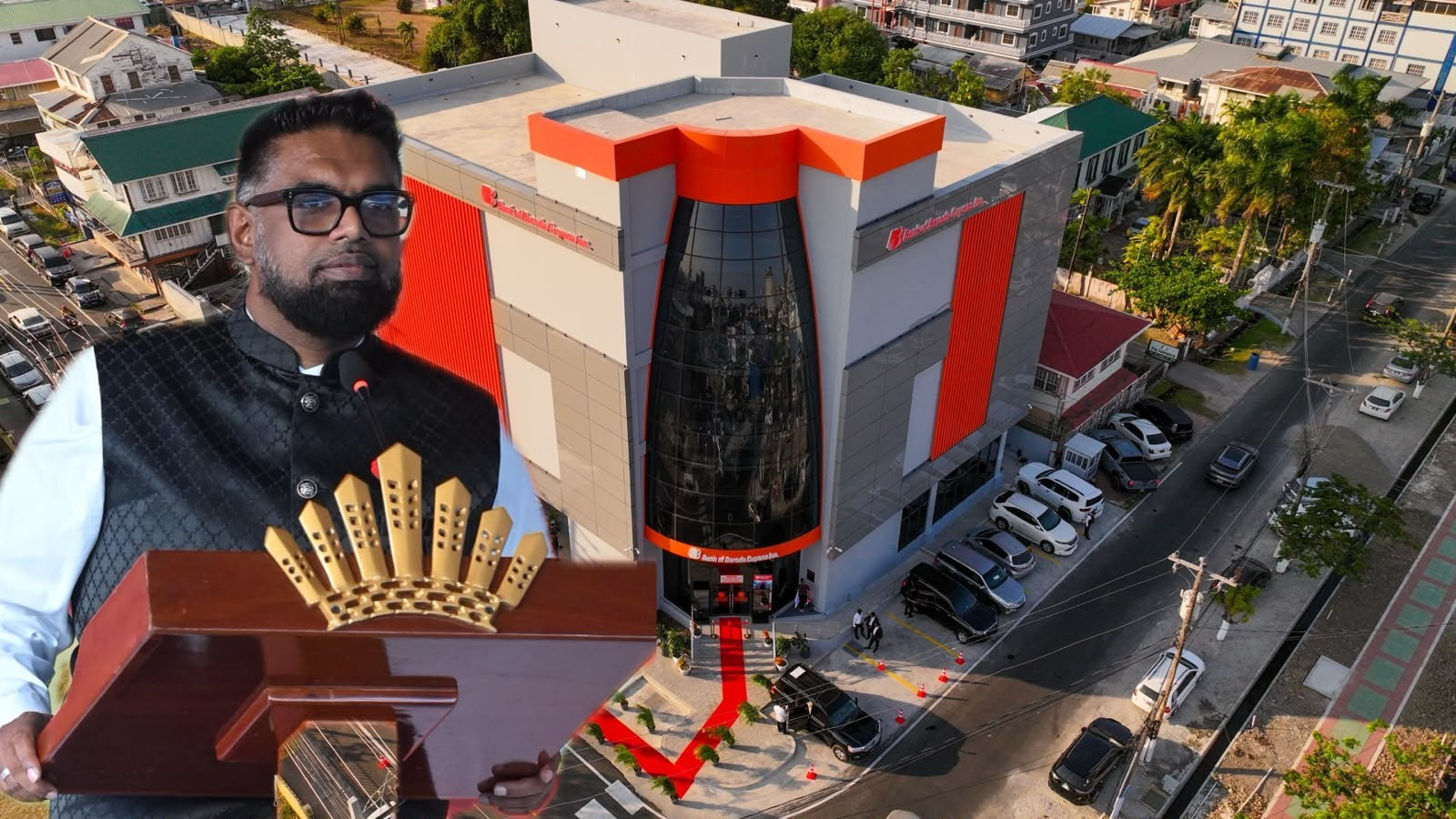
Georgetown, Guyana – President Dr Mohamed Irfaan Ali has called on the Bank of Baroda to direct more of its global capital towards Guyana, particularly by increasing financing opportunities for small businesses, entrepreneurs, farmers and manufacturers.
The President made the appeal on Friday evening while officially inaugurating the bank’s new headquarters at Carmichael and Quamina Streets in South Cummingsburg, Georgetown, as the financial institution celebrates 60 years of operations in Guyana.
Government Encourages Greater Support for Small Businesses
President Ali highlighted the important role commercial banks must play in supporting local businesses and strengthening the country’s economy.
He noted that the Government is working with commercial banks through the Guyana Development Bank (GDB) to provide additional financing of up to G$10 million for qualifying businesses.
The President described this initiative as an opportunity for financial institutions, including Bank of Baroda, to expand their lending portfolios and support businesses that contribute to employment, production and economic growth.
He emphasised that small businesses are essential to building a resilient economy, pointing to the contributions of entrepreneurs, manufacturers, farmers, service providers, contractors and retailers.
Bank of Baroda Expands Its Presence in Guyana
Reflecting on the bank’s history, President Ali recalled that when he assumed office in 2020, Bank of Baroda was considering leaving the Guyanese market.
He said retaining both Bank of Baroda and Scotiabank was among the early priorities of his administration, involving discussions with the institutions and the Ministry of Finance.
The President welcomed the opening of the new headquarters as a sign of the bank’s continued expansion and commitment to the local market.
Bank of Baroda received its licence to operate in Guyana in January 1966, shortly before the country gained independence. It became a wholly owned subsidiary of its parent institution in 1999 and opened its Mon Repos branch in 2012.
Digital Payments to Strengthen Financial Inclusion
The Head of State also highlighted the Government’s investment in a national payment system and digital platform designed to make financial services more accessible to people across the country.
He noted that mobile technology could help extend banking services to families and communities, supporting greater financial inclusion and improving the efficiency of transactions.
The initiative forms part of wider cooperation between Guyana and India to develop a digital public infrastructure system, including a payment platform modelled on India’s Unified Payments Interface (UPI).
Guyana’s Banking Sector Records Growth
President Ali pointed to several indicators reflecting the performance of Guyana’s banking sector.
At the end of 2025, the sector’s capital adequacy ratio stood at approximately 17 per cent, while liquid assets accounted for about 46 per cent of total assets. Non-performing loans declined to approximately 1.3 per cent of total loans, while private-sector credit recorded growth of around 19 per cent.
During the first half of 2026, domestic credit increased by 15.5 per cent, while private-sector credit grew by 11.5 per cent. Real estate mortgages also increased by 21.2 per cent.
Bank to Support Wider Development Financing
The President also referenced the US$500 million credit facility recently agreed between Guyana and India, which will support national development priorities, including defence, healthcare and infrastructure.
He noted that Bank of Baroda would play an important role in this financing arrangement, particularly in supporting projects that open new areas for housing, agriculture and manufacturing.
President Ali expressed hope that the bank’s new headquarters would become a centre for financing businesses, building partnerships and creating opportunities for entrepreneurs throughout Guyana.