






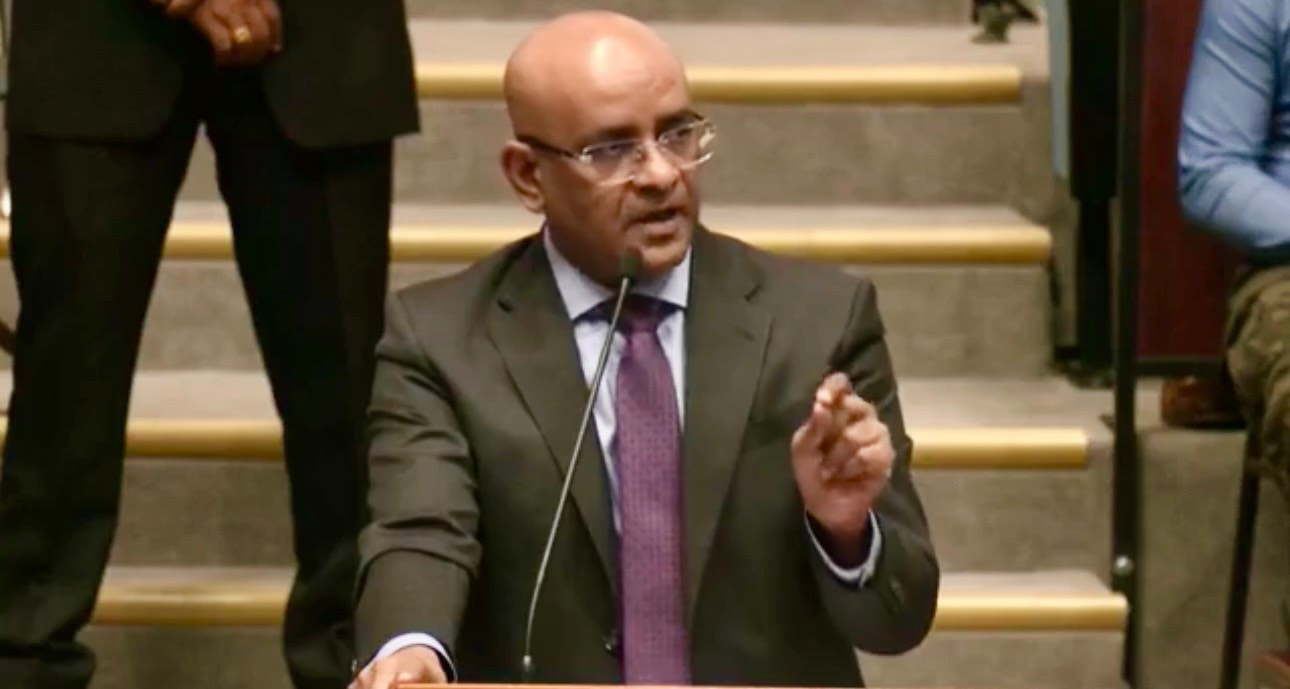
Georgetown, Guyana — Vice President Dr Bharrat Jagdeo has called on members of the Global Biodiversity Alliance (GBA) to align their efforts with the targets of the United Nations Convention on Biological Diversity (CBD), warning against creating parallel initiatives that could weaken existing international commitments.
Jagdeo made the call on Friday during the Second Global Biodiversity Alliance Conference and Financing Forum at the Arthur Chung Conference Centre in Liliendaal, Georgetown.
He said the alliance, which has expanded from 17 to 142 members, should strengthen international biodiversity commitments rather than seek to replace the established UN framework.
Department of Public Information, Guyana
GBA Must Support Existing UN Biodiversity Framework
The Vice President stressed that the Global Biodiversity Alliance should work in support of decisions made under the UN Convention on Biological Diversity.
He said the disappointing outcome of the recent COP17 conference in Armenia highlighted the need to restore international urgency around biodiversity protection and financing.
According to Jagdeo, the alliance should help governments and international negotiators address outstanding challenges while maintaining progress already achieved through global environmental agreements.
Three Major Challenges Facing Biodiversity Financing
Jagdeo outlined three significant obstacles affecting efforts to mobilise funding for nature conservation.
First, he said there is currently no established compliance or substantial voluntary market for biodiversity credits.
Second, public financing remains insufficient, with the global biodiversity funding gap estimated at approximately US$700 billion annually.
Third, countries and stakeholders have yet to reach agreement on a common definition and structure for biodiversity credits.
He argued that these challenges require detailed technical work, stronger international coordination and renewed commitment from governments and financial institutions.
Four Priorities for the Global Biodiversity Alliance
The Vice President identified four areas where the alliance should concentrate its efforts over the next phase of its development.
These include keeping biodiversity protection on policymakers’ agendas despite competing concerns such as energy prices, food security and regional conflicts.
He also called for the alliance to provide technical analysis to international negotiators, prevent the reversal of existing environmental commitments and demonstrate practical examples of successful conservation initiatives.
Jagdeo emphasised that the alliance should focus on meaningful technical engagement rather than creating additional layers of international bureaucracy.
Technical Research Needed to Develop Biodiversity Credits
Drawing on his experience as co-chair of the climate finance working group of Project Catalyst ahead of the 2009 Copenhagen climate negotiations, Jagdeo highlighted the importance of detailed research in developing credible environmental financing systems.
He recalled how technical work helped establish the economic case for forest carbon as a cost-effective way to reduce emissions.
The Vice President suggested that similar working groups could help resolve the many technical and policy questions surrounding biodiversity credits.
He said the alliance should return to focused discussions and research to develop workable approaches that countries can adopt.
Jagdeo Warns Against Penalising Forest Conservation Countries
The Vice President also raised concerns about proposals that could result in high-forest, low-deforestation (HFLD) countries such as Guyana receiving less financial recognition than countries that previously cleared large areas of forest and are now restoring them.
He argued that such an approach could create the wrong incentives by rewarding historical deforestation while failing to adequately recognise countries that have maintained their forests.
Jagdeo stressed that international financing arrangements must recognise the contribution of countries that continue to protect large areas of natural forest.
Guyana Highlights Results Under Low Carbon Development Strategy
Jagdeo pointed to Guyana’s Low Carbon Development Strategy (LCDS) as an example of how environmental financing can support conservation while delivering benefits to communities.
He said the strategy was developed without an existing model and has supported thousands of projects across Indigenous communities.
According to the Vice President, more than 3,000 projects have been completed in 252 Indigenous villages, using approximately 20 per cent of LCDS funding.
The remaining 80 per cent supports climate adaptation initiatives, including the construction and improvement of approximately 840 kilometres of canals and 125 kilometres of embankments.
He also highlighted Guyana’s environmental commitments amid rapid economic growth, including a 25 per cent increase in electricity demand over two years and the importation of approximately 40,000 vehicles annually.
Jagdeo said Guyana continues to maintain a no-flaring policy, applies a carbon tax on scheduled flaring and remains committed to protecting 30 per cent of its territory by 2030.
Guyana Reaffirms Commitment to Environmental Protection
Jagdeo reaffirmed that Guyana intends to maintain its commitment to environmental stewardship while pursuing economic development.
He said the country would continue supporting strong environmental protection measures at both national and international levels.
The Vice President’s remarks highlighted the need for the Global Biodiversity Alliance to strengthen existing UN commitments, develop practical financing solutions and ensure that countries protecting their natural resources receive appropriate recognition.
The conference provides a platform for governments, researchers, financial institutions and other stakeholders to discuss how biodiversity conservation can be supported through sustainable financing and international cooperation.