




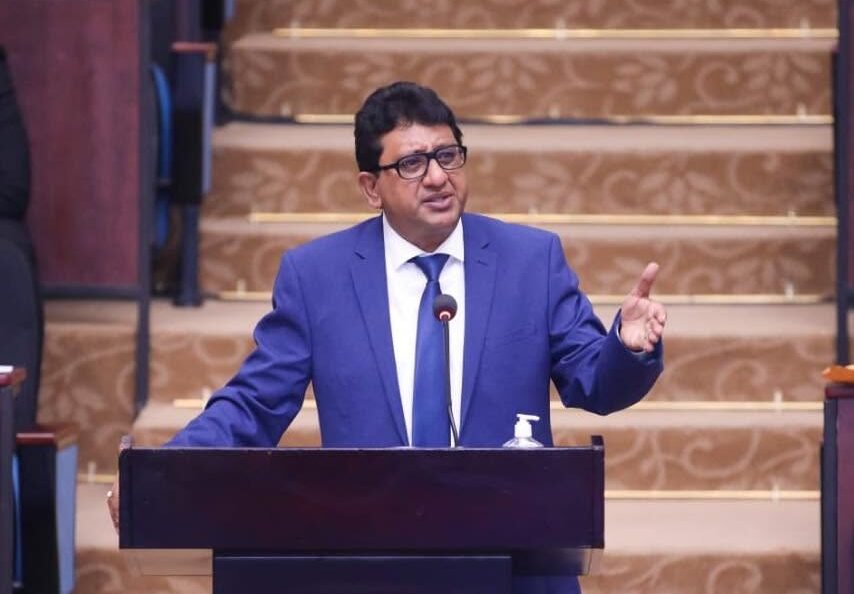
Attorney General and Minister of Legal Affairs Anil Nandlall, SC, has warned that Guyana cannot take the integrity of future elections for granted, arguing that the controversy surrounding the March 2020 General and Regional Elections remains a stark reminder of the need to safeguard the country’s democratic institutions.
Speaking on the Starting Point podcast, Nandlall was asked whether the reforms introduced after the 2020 electoral crisis were sufficient to prevent a similar situation from recurring. He expressed doubt that legislative safeguards alone could guarantee such an outcome and questioned whether the opposition had genuinely learned from the events that unfolded five years earlier.
Nandlall specifically pointed to the APNU+AFC coalition, arguing that the conduct surrounding the 2020 elections showed that democratic processes could be pressured even after Guyana returned to free and fair elections in 1992.
He compared it to the country’s electoral history from 1968 to 1985, a period marked by longstanding allegations of electoral manipulation. According to the Attorney General, the 2020 experience showed that Guyana could not assume that the practices and controversies of earlier decades were a thing of the past.
The Attorney General maintained that political forces associated with the disputed 2020 electoral process had failed to acknowledge their responsibility for what had occurred. He argued that continued denial of the controversy could have lasting consequences for the opposition’s public standing and electoral prospects.
The Attorney General, Anil Nandlall, reiterated this position earlier in his weekly programme, issues in the News, where he discussed the ongoing criminal proceedings stemming from the 2020 elections. He argued that opposition parties would struggle to regain public confidence if they kept accusing the People’s Progressive Party/Civic (PPP/C) of manipulating the election results.
“Once they continue to peddle that narrative that the PPP/C rigged those elections, they will continue to lose more votes at the elections,” Nandlall said, noting that he had expressed similar views repeatedly between 2020 and 2025.
He also criticised what he characterised as racially divisive political commentary, singling out discussions on Politics 101, hosted by Working People’s Alliance (WPA) co-leader Dr David Hinds, as well as on other political and social media platforms. Nandlall argued that such rhetoric could further undermine the opposition’s ability to attract voters.
The Attorney General linked his assessment to the September 2025 General and Regional Elections, which reshaped Guyana’s National Assembly. The APNU, led by Aubrey Norton, won 12 parliamentary seats, down from the 31 seats the APNU+AFC coalition secured in 2020.
The newly formed We Invest in Nationhood (WIN), led by US-sanctioned businessman Azruddin Mohamed, won 16 seats, making it the largest opposition party in the National Assembly. The results marked a significant shift in the balance of opposition representation.
Guyana’s 2020 elections were followed by months of political uncertainty and legal challenges, particularly over the tabulation of votes in Region Four, the country’s largest electoral district. The process attracted international attention and court intervention before the results were declared and the PPP/C took office in August of that year.
The controversy subsequently intensified calls for stronger electoral oversight, clearer procedures for vote counting and tabulation, and greater accountability among election officials.
Since regaining office in August 2020, the PPP/C administration has amended electoral legislation, including provisions of the Representation of the People Act. The changes were intended to strengthen transparency in the electoral process by publishing Statements of Poll, clarifying election officials’ duties, and improving vote-tabulation procedures. Additional measures addressed voter registration and penalties for electoral offences.
Criminal proceedings have also followed the disputed election. Those charged in connection with alleged electoral fraud include former senior Guyana Elections Commission (GECOM) officials, such as the former Chief Elections Officer, Deputy Chief Elections Officer, and Region Four Returning Officer. A former APNU+AFC Minister of Health, a former chief scrutineer for the coalition, and other former election staff have also been charged.
The Attorney General Anil Nandlall’s latest remarks underscore the ongoing political debate over the lessons from the 2020 elections, the effectiveness of subsequent reforms, and the responsibility of political parties and electoral officials to maintain public confidence in Guyana’s democratic system.