






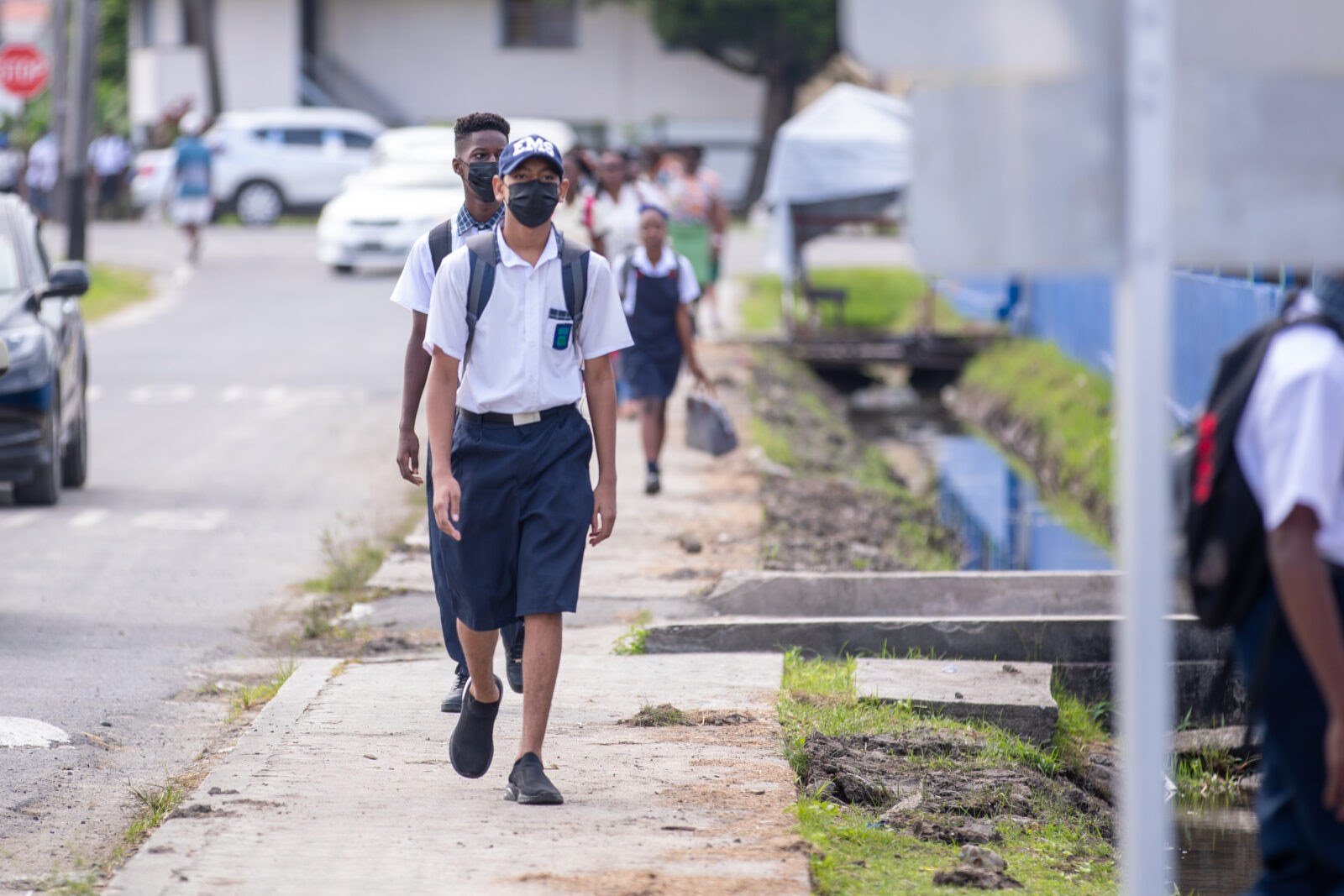
Guyana is on the cusp of achieving universal access to secondary education, as the President Irfaan Ali-led Government continues to expand school infrastructure, strengthen foundational learning and invest in Science, Technology, Engineering and Mathematics (STEM) education.
This is according to Minister of Education Sonia Parag, who was reflecting on her first year in office during the second term of the People’s Progressive Party Civic (PPP/C) Administration.
She highlighted the significant transformation across the education sector.
Minister Parag said the construction of more than 100 schools at the nursery, primary and secondary levels over the past five years has significantly improved access, particularly for children in rural and hinterland communities.

“With the completion of several secondary schools by the end of this year, we will be achieving universal access to secondary education,” Minister Parag said.
The minister said this represents a major milestone for Guyana, particularly for communities where students previously had to travel long distances or leave their communities to access secondary schooling.
She pointed to communities in Regions One, Seven and Nine, including remote areas such as Paramakatoi and other hinterland communities, where expanded school infrastructure is bringing education closer to children.
According to Minister Parag, the reduced need for students to travel long distances or live in dormitories to access schooling is already contributing to improved retention.
She noted that the most recent Caribbean Secondary Education Certificate (CSEC) results showed a strong retention rate among students who had entered the education system through the National Grade Six Assessment (NGSA) five years earlier.
“That retention rate was very, very good for CSEC as well, meaning that our students stayed on all five years. We didn’t have much of a dropout rate,” the minister explained.
She said this development demonstrates the impact of increased access to educational resources and infrastructure, and the government continues to broaden opportunities through Technical and Vocational Education and Training (TVET) and other specialised programmes.
Building the human capital for Guyana’s future
A major area of focus is STEM education, which Minister Parag described as critical to preparing Guyanese students for the changing world of work and the country’s expanding economy.
The government and ExxonMobil have made investments, over a 10-year period, to strengthen STEM education, including developing a STEM Centre at the University of Guyana’s Turkeyen Campus.
The facility is expected to serve as a major hub for STEM learning and development, with Minister Parag noting that it will be modelled on a similar facility in Houston, Texas.
In preparation for that investment, 62 students are being trained as teachers through the STEM teacher-training programme.

Minister Parag stressed that developing the physical infrastructure must be matched by investment in teachers who can deliver quality STEM education in classrooms.
“Having 62 new teachers coming out of this programme is going to help those children in our schools,” she said.
The education minister underscored STEM’s economic significance, noting that the disciplines are not isolated from other areas of national development.
“If you want to develop agriculture, for example, technology in agriculture, this is going to help that,” she said, adding that “STEM education will also help students become creative thinkers and critical analysts and develop their problem-solving abilities.”
She noted that stronger instruction in areas such as physics and chemistry, coupled with more targeted STEM education, will help Guyana develop the engineers, scientists and other professionals required to drive the country’s future development.
Strengthening the foundation
While infrastructure and access remain central to the government’s education agenda, Minister Parag said there would be equal attention paid to quality learning, starting at the primary level.
She highlighted the introduction of literacy assessments for students in Grades Two and Four as one of the key reforms implemented over the past year.
The assessments will identify students’ progress in reading and comprehension, allowing educators to intervene earlier and provide targeted support.

“We believe that literacy assessments are needed so that we can diagnose where a child is at, what level a child is at in terms of reading and understanding,” Minister Parag noted.
The objective, she explained, is to ensure that the majority, if not all, students leave primary school fully literate and better prepared to transition successfully into secondary education.
The PPP/C Government will further strengthen foundational learning by introducing numeracy assessments for Grades Two and Four in 2027.
Minister Parag said the move is to strengthen mathematics from an early age and develop students’ ability to reason and solve problems.
“We have to strengthen mathematics. We have to have our children from a young age build that foundation of analysing and becoming critical thinkers,” she iterated.
Investing in teachers
Teacher development will also form a major part of the ministry’s forward agenda.
Minister Parag said discussions were held with the Cyril Potter College of Education (CPCE) on areas where teacher training will be strengthened to improve the quality of instruction delivered across the education system.
She said strengthening teacher preparation, literacy and numeracy, STEM and other skill-based programmes will ultimately determine how effectively students are prepared for life beyond the classroom.
The minister emphasised that the government’s education reforms are being enabled by a broader objective, not simply improving examination performance, but equipping young Guyanese with practical skills and knowledge that can translate into employment and entrepreneurship.

She noted, “The idea behind all of this is not just to do it for show. But it’s actually to prepare our students to go out into the world of work.”
She said students must be able to apply what they learn to real-life situations.
She said students must have access to diverse skill sets that enable them to pursue different career pathways.
The continued expansion of infrastructure, universal secondary access, foundational literacy and numeracy assessments, teacher development, TVET and STEM therefore represents a broader transformation of Guyana’s education system, one aimed at ensuring that increased access is matched by quality, relevance and preparedness for the future workforce.
As Guyana’s economy continues to expand and diversify, the government is positioning the education sector to supply the skilled human capital needed to sustain that development, while ensuring that children, regardless of where they live, have greater access to the opportunities created by the country’s transformation.