






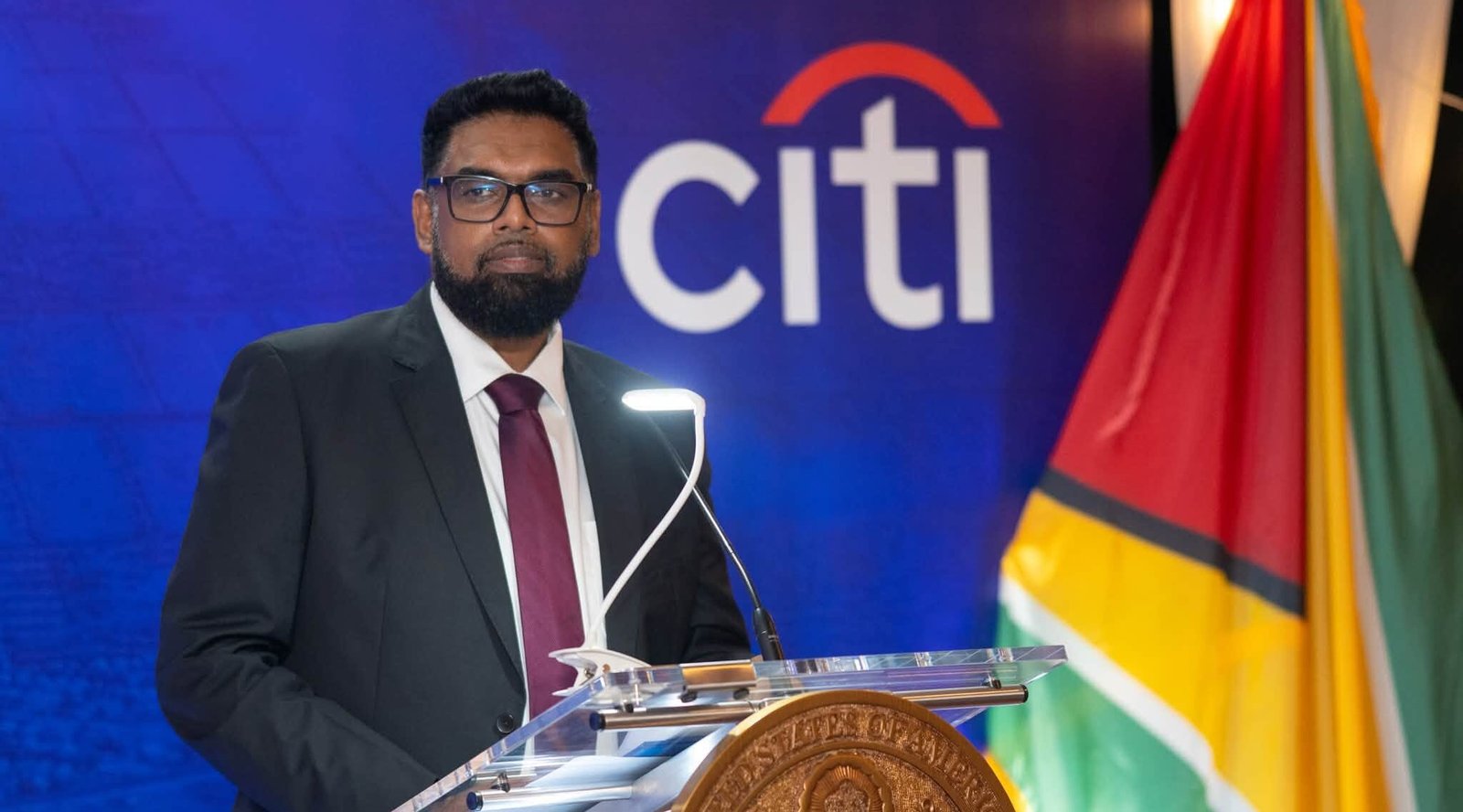
Guyana’s economy recorded robust growth in the first six months of 2026, with real gross domestic product expanding by an estimated 33.3 per cent and the non-oil economy growing by 10.1 per cent, President Dr Mohamed Irfaan Ali announced on Monday.
Speaking at a press conference, President Ali said the latest figures have prompted an upward revision of the country’s full-year growth forecast to 20.8 per cent for the overall economy and to 10.2 per cent for the non-oil sector.
He said the projected expansion would mark the sixth consecutive year of growth in Guyana’s non-oil economy, following the contraction in 2020.
According to the President, performance across several productive sectors indicates that economic expansion is occurring beyond the petroleum industry.
Mining and quarrying recorded an estimated 40.7 per cent increase in the first half of 2026, reflecting increased activity linked to construction, industrial development and other areas of the expanding economy.
In the mining sector, oil and gas production rose by 41.3 per cent, while bauxite output increased by 7.3 per cent. Gold and other mining activities also recorded notable gains, with the gold and mining subsector estimated to have grown by 11.3 per cent.
President Ali attributed part of the increase in recorded gold production to stronger government enforcement and to measures introduced to improve the declaration process and strengthen accountability within the sector.
He also highlighted the performance of other mining activities, including sand, stone, manganese and diamonds, which collectively expanded by an estimated 40 per cent.
The agriculture, forestry and fishing sector, however, faced challenges during the period. Despite higher transport and logistics costs and increased input costs, particularly for fuel, the sector recorded only a marginal 0.5 per cent contraction.
Several areas within agriculture, however, showed positive movement.
The sugar industry expanded by 19.3 per cent, while rice production increased by 4.4 per cent. Forestry recorded estimated growth of 15.4 per cent, and the fishing subsector expanded by 4.1 per cent.
Outside the primary industries, manufacturing grew by about 3 per cent, while the services sector expanded by 7.2 per cent.
President Ali said the figures indicate rising economic activity across multiple areas, with expanding industries expected to create jobs and raise household incomes.
He linked the expansion of productive activity to broader improvements in economic prospects, arguing that industrial growth creates jobs, raises earnings and supports further economic activity.
The President also cited developments within the financial system as another indicator of economic strength.
By the end of June 2026, net domestic credit had reached approximately $1.286 billion, representing a 15.5 per cent increase on the position recorded in December 2025.
Credit extended to the private sector increased by 11.5 per cent, while household credit rose by 14.6 per cent year on year, equivalent to an increase of approximately $75.8 billion.
President Ali said the expansion in lending demonstrates increased financial activity among businesses and households and is part of a wider picture of economic growth.
He questioned whether the combination of strong GDP performance, continued expansion of the non-oil economy, increased private-sector activity and growth across several productive industries could be anything other than evidence of a strengthening economy.
The President maintained that the latest indicators reflect not only rapid economic expansion but also greater diversification and structural development, with Guyana increasingly generating growth across sectors rather than relying solely on oil production.
With the full-year growth forecast now at 20.8 per cent, the government is expected to remain focused on sustaining investment, expanding productive capacity, and ensuring that the benefits of economic growth translate into employment and wider opportunities for Guyanese.