






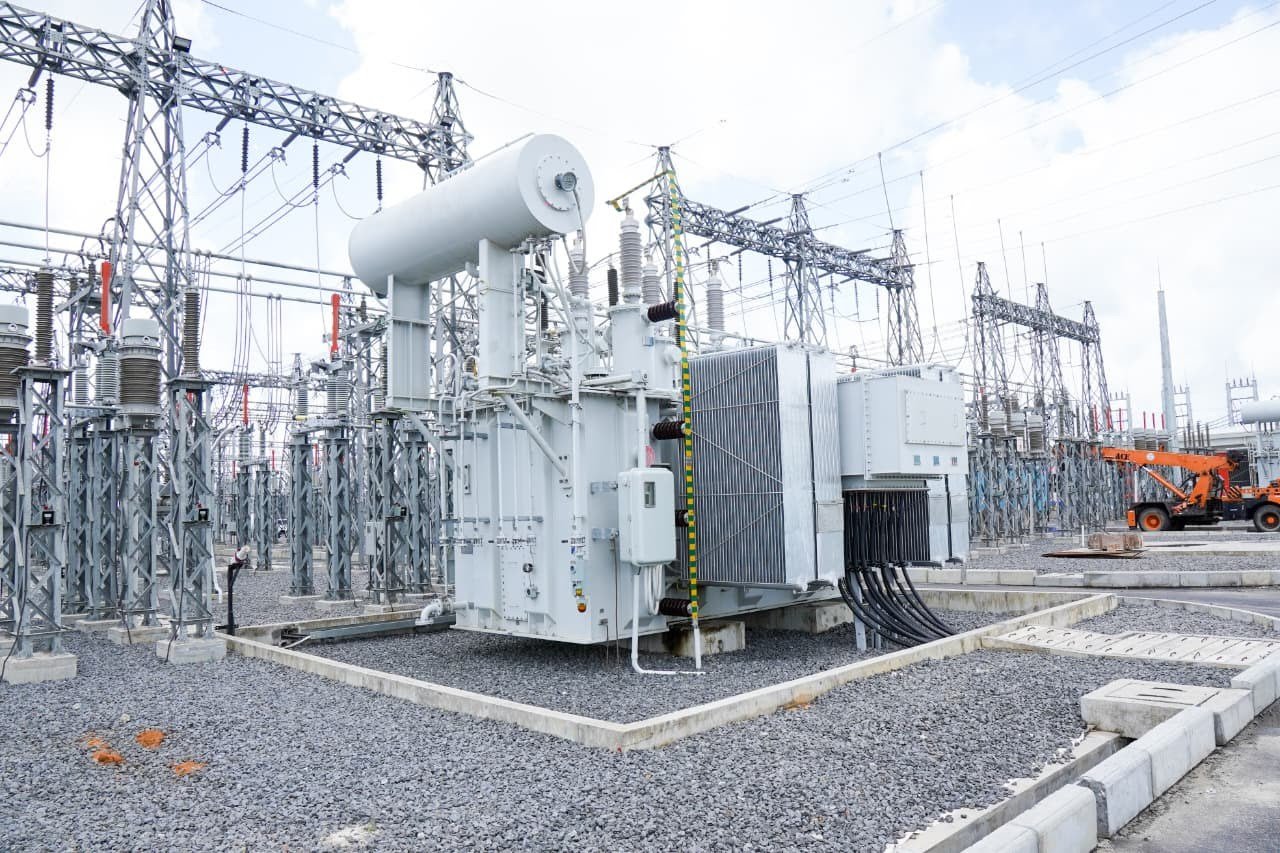
The construction of new substations at Chateau Margot and Enmore, along with the expansion of the Columbia Substation, is 60 per cent complete as the government advances major upgrades to its electricity network.
The facilities will form part of an expanded transmission system designed to accommodate additional generation, increase capacity and provide greater reliability for consumers.

Works are currently focused on foundations, with some already completed and others progressing.
Guyana Power and Light (GPL) Chief Executive Officer Kesh Nandlall said equipment and towers for the Chateau Margot Substation are also being mobilised.
“You will soon see the towers coming in and towers going out,” Nandlall said.
He explained that electricity entering the substation at 69 kilovolts (kV) will be reduced to 13.8 kV for distribution, while the transmission network will continue towards Columbia.
This arrangement will create alternative routes for moving electricity across the network, providing greater redundancy if sections are affected by faults or taken offline for maintenance.

The new infrastructure will also strengthen electricity supply along the East Coast Demerara, where continued development is increasing demand.
“This will now bring resilience to this part of the East Coast, including industrial sites that are going to commence. This substation will provide electricity to new customers and also to existing customers where we have feeders that are taxed at the moment,” he said.
GPL Deputy CEO for Strategic Operations Bharat Harjohn explained that substations are critical to safely moving electricity from generating facilities to consumers.
He said electricity generated by turbines at the 300-megawatt Gas-to-Energy plant at Wales, for example, will be produced at 13.8 kV.
To efficiently transmit that electricity over long distances and minimise losses, the voltage will be increased to 230 kV.
It must then be reduced before reaching consumers, with homes, businesses and industrial facilities requiring much lower voltages.
Transformers at substations perform this function by either increasing voltage for long-distance transmission or reducing it to levels suitable for distribution and consumption.
Meanwhile, work is progressing on the transmission lines that will connect the new and expanded substations.
Approximately 155 kilometres of 230 kV double-circuit transmission lines will connect the Goedverwagting Substation with a new substation at Williamsburg, Region Six. Another 167 kilometres of 69 kV double-circuit transmission lines will replace existing infrastructure along the railway embankment.
The investment intends to increase transmission capacity, accommodate new generation and support the introduction of smart-grid technology.
It will also create a more interconnected electricity network with multiple transmission routes and backup infrastructure, reducing the risk of widespread outages when equipment fails or requires maintenance.