





President Dr Mohamed Irfaan Ali says Guyana’s oil boom is providing a historic opportunity to transform the South American nation through major investments in infrastructure, energy, healthcare and education.
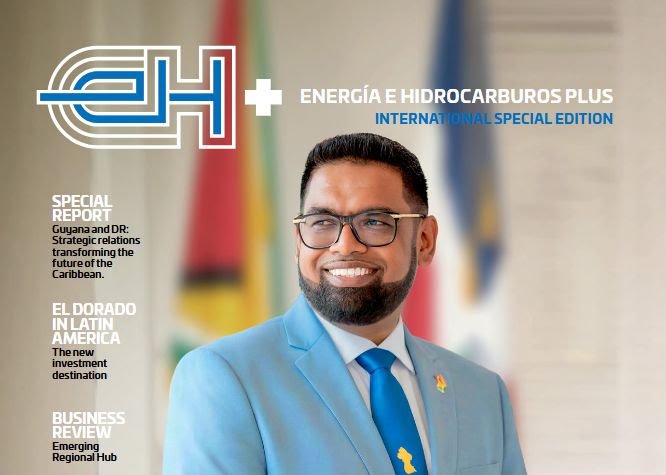
In an interview with Energía e Hidrocarburos Plus (EH+), a specialised multimedia platform and print magazine focused on the energy, hydrocarbons, and economic sectors of the Dominican Republic and the broader Caribbean, President Ali outlined an ambitious vision for a country that has become one of the world’s fastest-growing economies following the discovery of more than 11 billion barrels of offshore oil reserves.
At the centre of the government’s development agenda is Vision 2030, a plan aimed at modernising infrastructure and expanding economic opportunities across the country.
Among its flagship projects is the New Demerara River Bridge. The president described it as “a physical manifestation of one of our national ambitions of turning geographic divides into economic gateways”, adding: “This project is a critical artery that pumps life into Vision 2030.”

The bridge forms part of a wider programme that includes the government’s Gas-to-Energy initiative and major transportation projects.
“Beyond bridges, we are building the foundational pillars of a new Guyana,” he said. “We are not just building infrastructure; we are building the skeleton of a new nation.”
The president said international partnerships are helping drive that transformation.
“We subscribe to sovereign partnerships, not paternalism,” he said, citing cooperation with countries including India and the United States, as well as regional and multilateral institutions.
Guyana’s growing oil sector has also elevated its international profile.
“With over 11 billion barrels and counting, we are not just an oil producer; we are a new global energy anchor,” Ali said.
While oil revenues are reshaping the economy, President Ali said the government is focused on avoiding the “oil curse” often associated with resource-rich nations.
“We are defying the so-called ‘oil curse’ by ensuring that our oil wealth is a down payment on our children’s future, not a lottery ticket for today,” he said.
He pointed to Guyana’s Natural Resource Fund as a safeguard for long-term development, describing it as “our fortress of fiscal responsibility”.
According to President Ali, oil revenues are being channelled into public services and infrastructure.
“Oil revenues are our national seed capital,” he said. “We are planting today the forests of opportunity that will shelter generations to come.”
Regionally, the president emphasised the importance of partnerships through organisations such as CARICOM and highlighted growing ties with countries such as the Dominican Republic.
“From energy and food security to tourism and trade, we are not just neighbours; we are natural partners in progress,” he said.
The interview also offered a glimpse into President Ali’s personal approach to leadership. Asked about his morning routine, he said it begins with “a moment of quiet prayer, gratitude and focus. Before I lead a nation, I must centre the man.”
He credited his parents for shaping his sense of public service, saying they taught him “that service is the rent you pay for your place on Earth.”
Guyana’s head of state acknowledged the challenges of leadership, particularly when difficult decisions are required.
“Making decisions that, while necessary for the nation’s long-term health, may cause short-term pain remains one of the most uncomfortable aspects of the job,” he said. “Leadership is not about popularity; it is about stewardship.”
Looking toward 2030, President Ali said he envisions a Guyana that combines economic growth with environmental sustainability, expanded public services and deeper regional integration.
Reflecting on the responsibilities of office, the president said, “The weight of expectation is a constant companion. Behind the confidence is the profound fear of failing the hope in a child’s eyes.”