





Big, powerful countries continue to use multilateral organisations as minefields to gain dominance. Small countries, many very poor, try to navigate the treacherous minefields to ensure they are not eaten up. Small countries like Guyana face the dilemma that they must be in those minefields to gain benefits for their people, but they know that there are risks. Guyana has done well to navigate these minefields without being blown up, thanks to prudent management of international affairs by our Government.
This past week (March 26–29), the World Trade Organization (WTO) held its 14th Ministerial Conference (MC) in Yaoundé, Cameroon. The 15th WTO MC in 2028 will be held in Saudi Arabia. Ruminations advocates that Guyana should seek to host the WTO 16th MC in 2030.
At the 14th WTO’s MC, one thing is clear – the struggle for global domination of digital trade (e-commerce trade) is heating up. America is a clear front-runner in a fierce struggle to dominate e-commerce. But the US knows fully well that China, India, Japan and the EU will not stand by and allow them space to expand their dominance in e-commerce.
Because America wants to and believes it will continue to dominate global E-commerce, it is seeking to protect its big tech companies by having countries around the world agree to WTO rules prohibiting custom taxes on digital trade through an E-commerce moratorium. But Brazil and other countries blocked the US from achieving its goal at MC14 of a permanent moratorium.
The Guyanese Government has been aggressively pursuing policies for the full digitalisation of society. All taxes, including custom taxes, on digital trade were zero in Guyana before 2015 and since 2020 under successive PPP Governments. Between 2015 and 2020, the David Granger-led PNC/APNU/AFC Government introduced various digital trade taxes, excepting custom taxes because the WTO since 1998 has had in place successive two-year moratoriums on custom taxes on digital trade. It was this WTO moratorium that prevented, between 2015 and 2020, the then PNC-led Government from introducing custom taxes on digital trade.
The US and some other countries want the WTO rules to include an agreement for a permanent moratorium on custom taxes on digital trade. India and some other countries want an agreement for no moratorium, allowing sovereign policy space for countries to apply custom taxes on digital trade if they so desire. Other countries, including Guyana and CARICOM countries, advocate for a temporary moratorium, arguing that digital trade is growing rapidly and the WTO should agree to continue a temporary moratorium. In the end, no agreement on any of the options was achieved at MC14. Work to agree on a custom taxation policy at the global level must now continue in Geneva, where the WTO is located.
This debate has been ongoing since 1998, as both the US and India led coalitions for either a permanent moratorium (the US-led coalition) on custom taxes on digital tools or no moratorium (the India-led coalition). The WTO MC in 1998 could not agree on either of these two positions. Subsequent WTO MCs, including all those up to 2024, however, were only able to preserve the temporary moratorium because the Ministers continue to be divided between the US-led and the Indian-led positions. It has been 28 years, and many WTO members urged that the 14th Conference in Yaoundé be the time to end the dispute and decide one way or the other. The WTO Ministers in Yaoundé failed once again to agree on one of these options.
In the end, even though Ministers agreed to a compromised temporary moratorium, they could not agree on how long: Brazil demanded a two-year-long moratorium, India a four-year moratorium and America a five-year moratorium. The consequence is that the moratorium which has existed since 1998 has expired. If this situation had existed between 2015 and 2020, the then PNC-led Government in Guyana would certainly have taken the opportunity to introduce custom taxes on digital trade.
The expiration of the moratorium on e-commerce does not automatically trigger tariffs on digital trade, since WTO members can continue to individually choose not to impose customs duties on online goods and services ranging from e-books, online courses, music, cybersecurity, and telemedicine to AI.
It is noteworthy that the fiscal impact of the forgone customs revenue is generally small—only 0.68 per cent of total customs revenue, or 0.1 per cent of total Government revenues. The advantages of expanding the global digital economy outweigh these minor revenue losses. Ironically, lifting the moratorium, as has happened because of the failure of the MC14 to renew the moratorium, could disproportionately affect lower-income countries as digitalisation becomes more expensive, further exacerbating the gap between high-income and low-income countries. It is why successive PPP Governments in Guyana have never introduced taxes, including custom taxes, on e-commerce.
All is not lost. The negotiations will continue, starting in May in Geneva. Guyana will be an active participant in these negotiations, with the team led by Ambassador Leslie Ramsammy. In addition, in the absence of a multilateral agreement at the WTO, there is an E-Commerce Agreement (ECA), led by Australia, Japan, and Singapore, and endorsed by 66 WTO members, representing 70 per cent of global trade, which is a weaker version of the WTO E-Commerce moratorium on customs duties on electronic transactions. This is a plurilateral agreement not yet integrated into the WTO rules. America and India are not part of this agreement, but China, the EU, Canada, the UK, Chile and Colombia are.
As digital and AI tools become an important part of daily lives, the battle for dominance in e-commerce has intensified. Custom duties are part of this struggle for dominance. Whether we live in Guyana or somewhere else in the world, we are caught in another struggle for global dominance in another aspect of our daily lives.
Subscribe to Updates
Get the latest news from DemocracyGuyana.com
Digital trade – powerful countries in new global struggle for domination
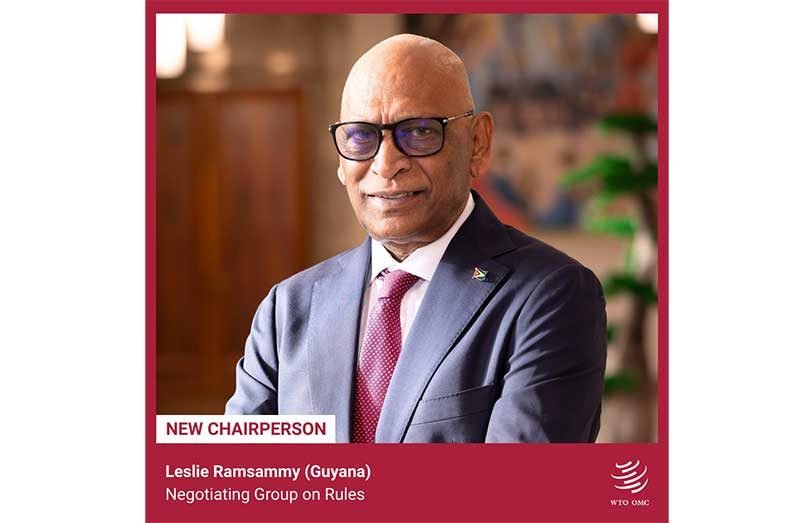
New chairperson, Dr. Leslie Ramsammy