






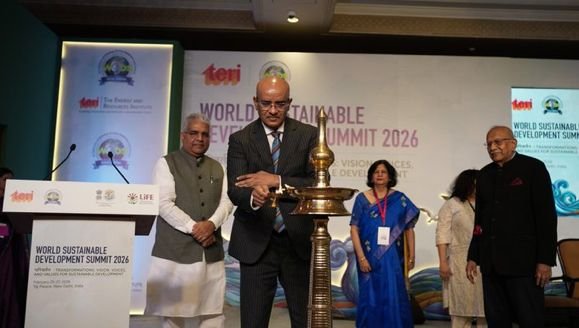
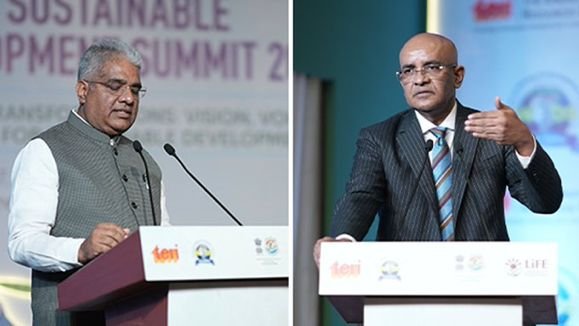
Guyana’s growing reputation as a global sustainability leader was reinforced at the World Sustainable Development Summit (WSDS), held at the Taj Palace in New Delhi, India. Vice-President Dr. Bharrat Jagdeo delivered the summit’s inaugural address, placing Guyana’s environmental model and climate strategies at the centre of international discussions on sustainable development.
The annual summit, organised by The Energy and Resources Institute (TERI), is one of the world’s most respected forums for dialogue on climate action, environmental governance, and green economic transformation. The gathering brings together heads of state, ministers, climate experts, researchers, corporate executives, and civil society representatives, all working towards practical solutions to global environmental challenges. India’s Minister for Environment, Forest and Climate Change, Bhupender Yadav, along with other international leaders, also addressed the opening session.
Under the summit’s theme, “Transformations through Vision, Voices and Values for Sustainable Development,” Dr Jagdeo highlighted Guyana’s distinctive development pathway—one that integrates environmental stewardship with economic progress. He drew attention to the country’s vast forest cover, noting that approximately 86 per cent of Guyana’s landmass remains covered by primary forests, giving it one of the lowest deforestation rates globally. Despite being geographically comparable in size to the United Kingdom, Guyana has maintained a remarkably strong conservation record.
A major focus of the Vice-President’s address was the monetisation of forest carbon. Guyana has successfully positioned its forest resources as a high-quality carbon asset, generating substantial international revenue. The country has already sold 30 per cent of its forest carbon credit for US$750 million, demonstrating the financial viability of preserving tropical forests. According to Dr Jagdeo, this achievement illustrates the immense economic potential of global forest conservation if scaled appropriately.
He further noted that Guyana has made progress in entering formal carbon markets, marking a significant milestone for developing nations seeking to benefit from structured environmental finance systems. The country has sold millions of carbon credits into established markets, thereby reinforcing the credibility of its forest monitoring and carbon accounting systems.
In addition to carbon markets, Guyana has taken steps to advance biodiversity protection through international cooperation. The Global Biodiversity Alliance, launched in Guyana in July of the previous year, now includes dozens of member organisations. The initiative aims to promote nature-positive business models, mobilise conservation financing, and develop implementable strategies to safeguard ecosystems. Dr Jagdeo emphasised the importance of expanding global participation in the alliance to strengthen biodiversity protection worldwide.
Addressing the often-debated relationship between fossil fuel production and sustainability, the Vice-President argued that environmental responsibility and energy development can coexist. Guyana is expected to significantly increase its oil output over the coming years, potentially reaching between 1.5 and 2 million barrels per day. However, he maintained that with strong governance and strategic planning, natural resource development can be aligned with sustainable national policies. He highlighted leadership, policy clarity, and accountability as essential to balancing growth with environmental protection.
Beyond forests and energy, Dr Jagdeo also emphasised the importance of technological innovation in sustainable development. He highlighted the growing role of artificial intelligence and emerging technologies in addressing environmental challenges and urged support for developing nations in integrating these tools into national planning frameworks. He stressed that ensuring smaller and vulnerable states are not excluded from technological advancement is critical for equitable global development.
Dr Jagdeo’s participation at the summit comes shortly after he was recognised with the prestigious Sustainable Development Leadership Award. In 2025, he was named among a select group of global leaders honoured for transformative contributions to climate action, environmental conservation, and sustainable development.
Guyana’s presentation at the WSDS underscored the country’s ambition to position itself as both an environmental custodian and an emerging energy producer. Through forest conservation, biodiversity initiatives, engagement with the carbon market, and strategic resource management, the nation continues to shape a development model that is attracting increasing global attention.