






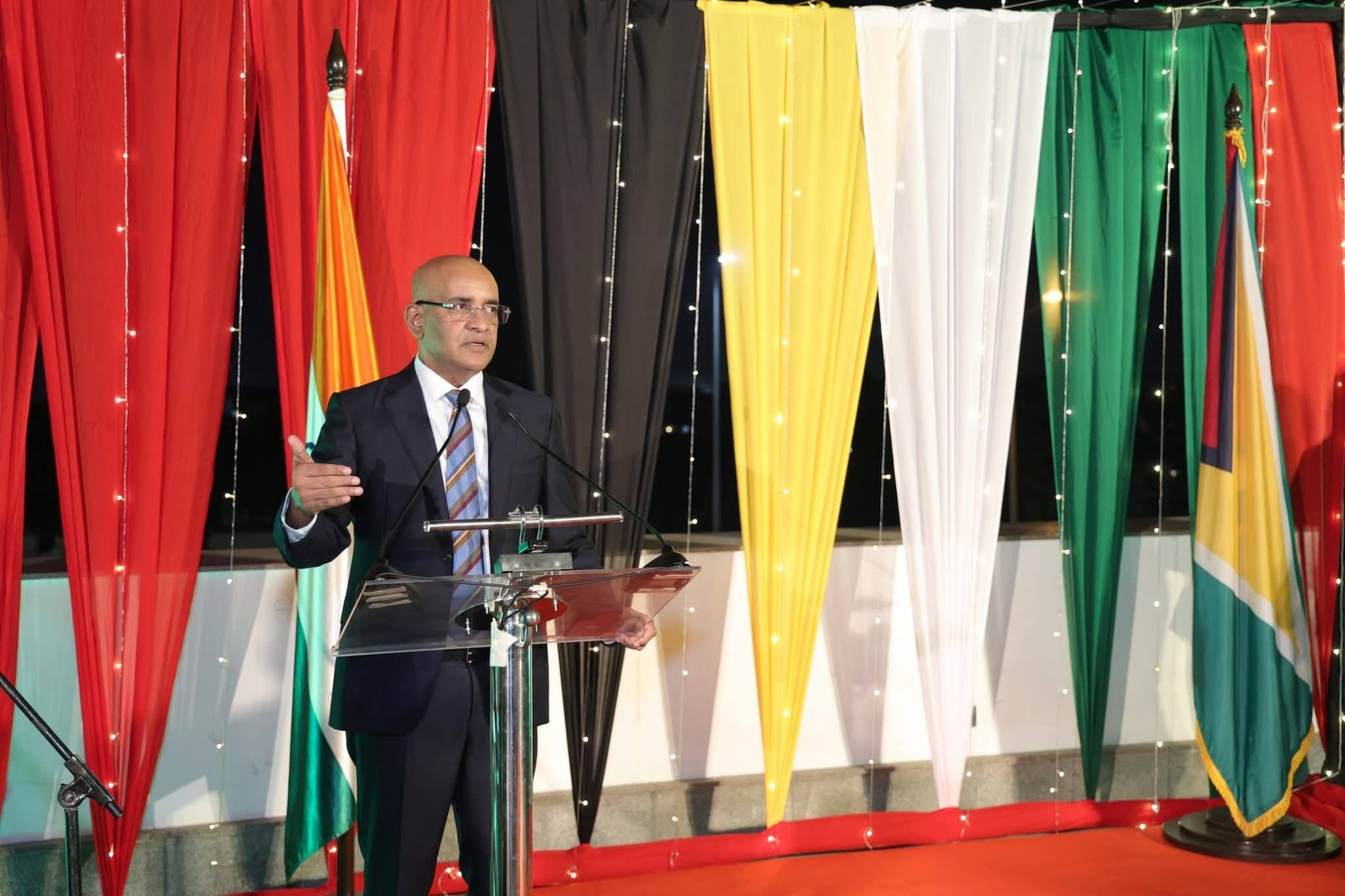
At the World Sustainable Development Summit (WSDS) in New Delhi, Guyana’s Vice President, Dr Bharrat Jagdeo, delivered a forceful call for the Global South to harness Artificial Intelligence (AI) as a transformative tool for sustainable development—warning that without urgent support, smaller nations risk being left behind in a new technological divide.
Speaking at the annual summit hosted by The Energy and Resources Institute (TERI) at the Taj Palace Hotel, Dr Jagdeo emphasised that discussions about sustainability can no longer exclude AI. According to him, technological transformation is reshaping every sector, and countries that fail to integrate AI into national planning risk deepening existing development gaps.
Preventing a New Digital Divide
Dr Jagdeo highlighted that while countries such as India possess strong technological infrastructure and human capacity, many small states across Africa, the Caribbean, and the Pacific do not. These nations, he cautioned, could face a “computer and data divide” on top of longstanding economic and institutional challenges.
To prevent this outcome, he urged international institutions to develop practical templates and structured frameworks that small developing states can adopt. Rather than leaving governments to navigate AI integration independently, Dr Jagdeo called for coordinated global support to help policymakers understand AI’s implications for education, healthcare, climate monitoring, and economic planning.
He stressed that awareness-building is essential, noting that many policymakers remain uncertain about AI’s developmental impact. Just as climate considerations have been gradually embedded in national development strategies over the past decade, he argued that AI must now be incorporated as a core planning variable.
Guyana’s Development Model
Turning to Guyana’s experience, Jagdeo presented the country as an example of how small states can leverage natural resources while maintaining environmental stewardship. He cited Guyana’s Low Carbon Development Strategy (LCDS), first introduced during his presidency in 2009, as a pioneering effort to monetise forest conservation.
Under this framework, Guyana secured US$750 million from the sale of 30 per cent of its forest carbon credits—demonstrating, he said, that environmental protection and economic advancement need not be mutually exclusive. At the same time, he acknowledged Guyana’s rapidly expanding oil and gas production, projected to reach roughly 2 million barrels per day in the coming years. He argued that responsible resource management can coexist with sustainable planning.
However, Dr Jagdeo expressed frustration that forest carbon credit remains undervalued globally, with most transactions confined to voluntary markets rather than to binding compliance systems. For forest-rich developing nations, he suggested, fairer valuation mechanisms are essential to make conservation economically viable at scale.
The Economics of Climate Action
A central theme of Jagdeo’s address was that climate advocacy must increasingly rest on economic logic. He argued that political momentum strengthens when environmental policies align with profitability and industrial opportunity.
He cited the rise of the solar manufacturing and electric vehicle industries in countries such as India and China as evidence that climate solutions can become engines of economic growth. By framing sustainability as smart economics rather than sacrifice, governments can attract broader political and public support.
At the same time, he acknowledged the geopolitical tensions affecting global climate cooperation. Referring to the United States’ absence from certain climate engagements, Jagdeo noted that achieving global climate targets becomes significantly more challenging without the participation of major economies. Nonetheless, he urged stakeholders to identify pathways forward even amid shifting alliances and uncertainties.
Biodiversity as Common Ground
Dr Jagdeo also spotlighted Guyana’s recently launched Global Biodiversity Alliance, suggesting that biodiversity conservation could serve as a unifying platform—even for those sceptical of climate-focused agendas. In some regions, he observed that individuals who question climate policies may still strongly support wildlife and ecosystem protection. Harnessing biodiversity could therefore broaden consensus on environmental preservation.
International Recognition
The summit, widely regarded as one of the leading global forums for sustainability and climate dialogue, brought together policymakers, researchers, and environmental leaders from around the world. India’s Environment Minister Bhupender Yadav and other international figures also addressed the gathering.
In recognition of his contributions to climate advocacy and sustainable development, Jagdeo was recently named one of just 18 recipients of the Sustainable Development Leadership Award—one of the summit’s highest honours. The distinction places him among a select group of global leaders recognised for advancing environmental protection and sustainable growth strategies.
A Call for Integrated Transformation
Dr Jagdeo’s message in New Delhi underscored a broader shift in global development thinking: climate resilience, biodiversity protection, and digital transformation are no longer separate agendas. For small states in the Global South, the challenge is not only adapting to climate change but also ensuring they are not excluded from the technological revolution reshaping global economies.
By combining AI-driven innovation with economically grounded climate strategies, Dr Jagdeo argued that developing nations can move beyond vulnerability and become active participants in shaping a more sustainable and technologically inclusive future.