






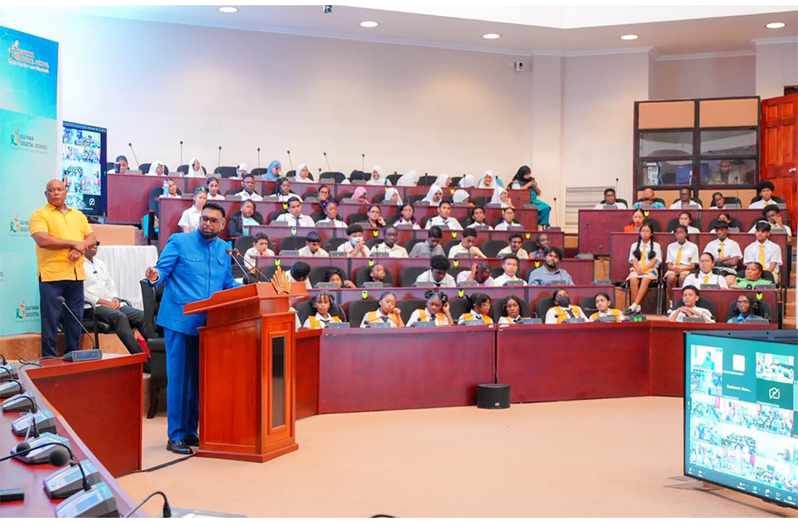
President Dr. Irfaan Ali on Friday unveiled the Guyana Digital School (GDS), calling it a groundbreaking step toward regional unity and education prepared for the future. Speaking to a packed crowd at the Arthur Chung Conference Centre (ACCC), he described the platform as a significant national milestone and a regional investment in equality, connection, and opportunity.
Dr. Ali explained that the new digital system creates a virtual space where learners from Guyana and other Caribbean countries can study together in a single classroom, share the same resources, and build a shared regional identity. He emphasized that this is the first time children from Barbados, Belize, St. Lucia, Montserrat, St. Kitts and Nevis, and Guyana have access to the same online learning environment, breaking longstanding barriers of distance and unequal access.

“We are building a future where our children see themselves not just as one Guyana but as one region,” he told students, teachers, and regional representatives. “This is about lifting each other up.”
Dr. Ali described the launch as emotional and historic, rooted in values of dignity, love, and equal opportunity. He said many previous generations were held back by poverty and lack of resources, but today’s young people are being given tools that would have been unimaginable decades ago.
He emphasized that education should be a space for encouragement rather than competition and urged learners to prioritize friendship, curiosity, and positivity over conflict and division. “Life is about building friendships and supporting each other,” he said. “It is not about fighting or guns.”
The President explained that the Guyana Digital School is more than just an education project; it is a national development strategy aimed at creating a skilled and resilient population. By providing access to digital tools, online content, and hands-on learning environments, children from all regions of Guyana can learn at the same standard and pace.
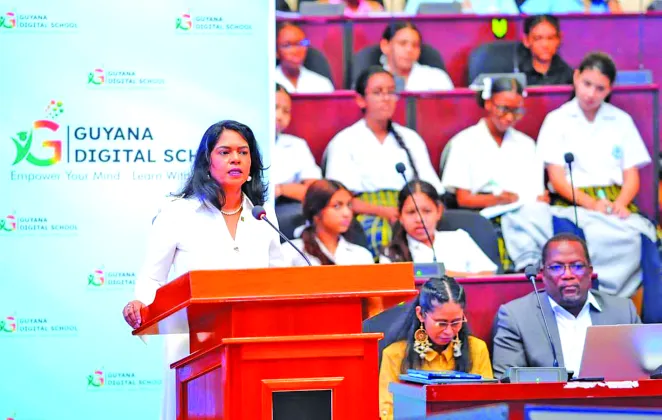
He stated that the launch positions Guyana to compete globally as the world undergoes rapid technological change. He noted that the Fourth Industrial Revolution was powered by artificial intelligence, robotics, biotechnology, data, and automation. Countries that do not keep up will fall behind.
To demonstrate the rapid pace of technological progress, the President announced that Guyana will perform its first robotic-assisted surgery next year, with specialists based in the United States. He stated that similar advances are transforming agriculture, finance, manufacturing, transportation, and medicine.
Dr. Ali highlighted that for decades, developing countries have struggled with a digital divide that has hindered global competition. While more than 90 percent of homes in developed nations have reliable internet access, this number can fall below 40 percent in low-income countries. “Digital learning is not optional,” he said. “A digital workforce requires digital skills.”
One of the main features of the Guyana Digital School is its online library, which will include every textbook used for CXC exams and several other levels of study. Dr. Ali said this removes one of the most significant barriers to learning. “All our children will now have no excuse when it comes to textbooks,” he said. “Imagine the power of that.”
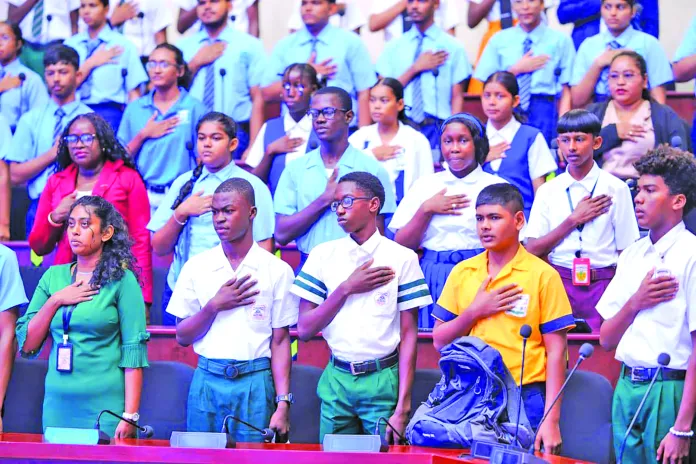
The platform will support teachers, students, adult learners, out-of-school youth, and people with disabilities, helping to close gaps in both education and opportunities. The President said that the challenges faced during COVID-19 highlighted the importance of strong online tools and connectivity, especially in remote and riverine communities.
Dr. Ali urged learners to seize the opportunities ahead. He stated that what is being built today forms the technological foundation for Guyana’s next generation. Data centers, innovation hubs, and advanced industries are part of the long-term vision, and the Digital School is one of the investments that will influence Guyana’s competitiveness in the coming decades.
“The jobs our children will compete for may not exist yet,” he said. “The technologies they will use may not have been invented. This is not a response to today’s needs; it is an investment in tomorrow’s potential.”
He expressed gratitude to the Ministry of Education, the Ministry of Public Service, and the many partners who made the launch possible.
“This is just the beginning,” President Ali said. “We will walk this journey together—united, strong, and filled with dignity and hope.”